Everything between a hunch and a signed contract.
SportOS-FB combines the data engine, the intelligence layer and the daily workflow tools that agencies and clubs usually stitch together from five products and a spreadsheet.
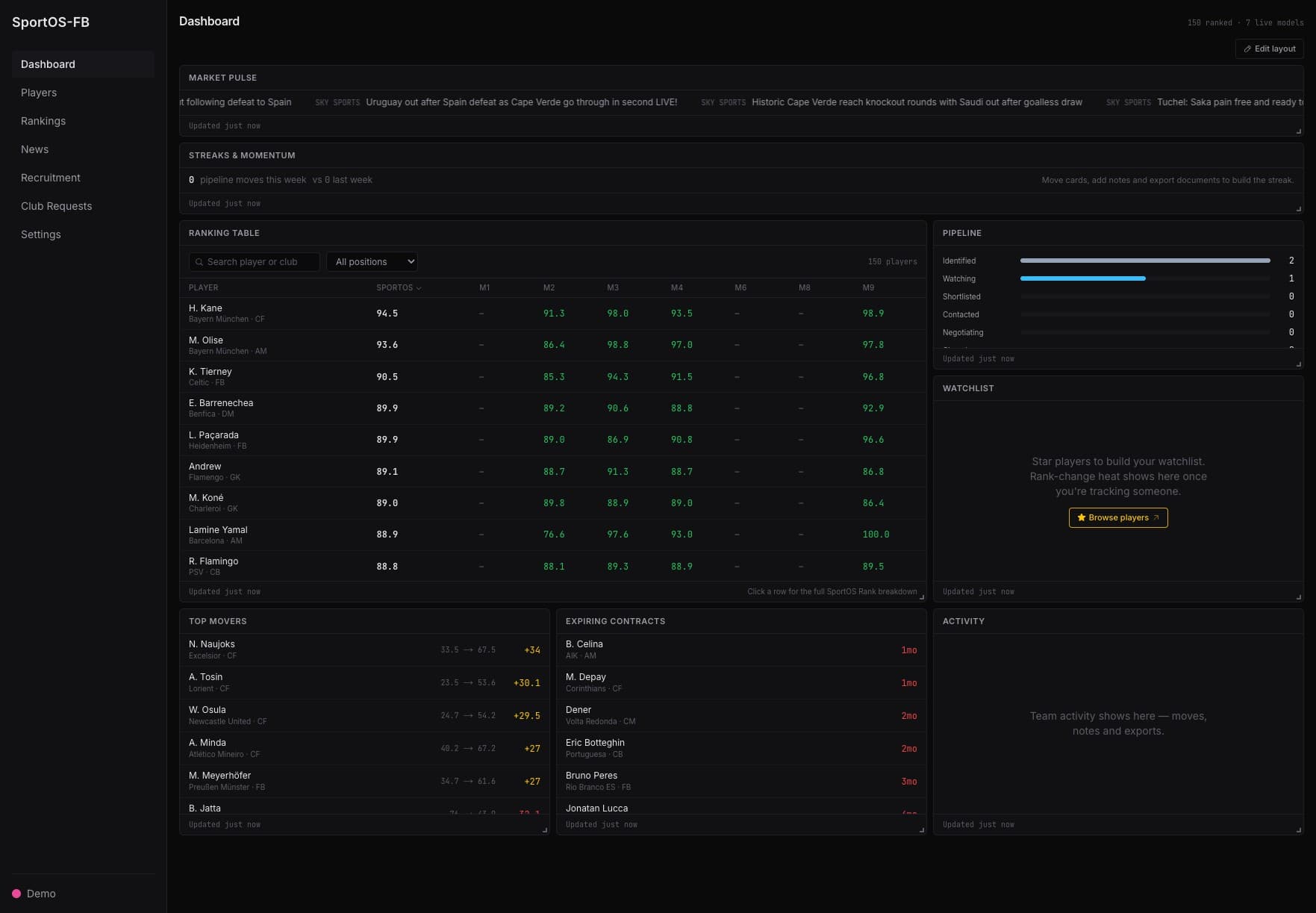
A dashboard with the density of a trading terminal
Live ranking table sortable by any model, market pulse, top movers, expiring contracts and your pipeline at a glance. Every widget shows its source and freshness, and the layout is yours to rearrange.
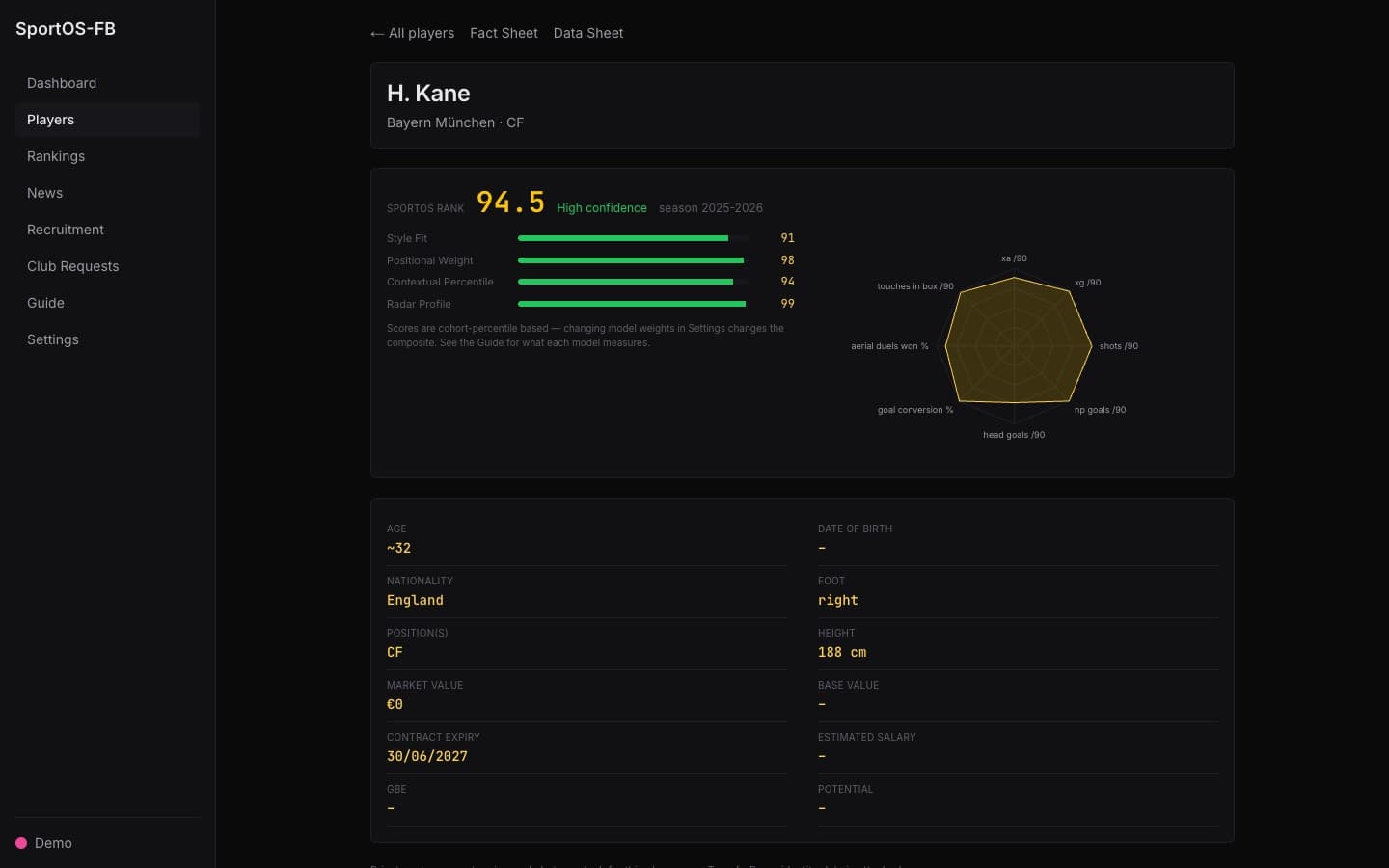
Ten ranking models. Your weights, your view.
TransferRoom ratings, style fit, position-specific KPIs, contextual percentiles, market and agent opportunity and more, blended into one SportOS Rank. Change the weights and the whole ranking re-shapes around your strategy. Every score carries its per-model breakdown, cohort context and a confidence badge.
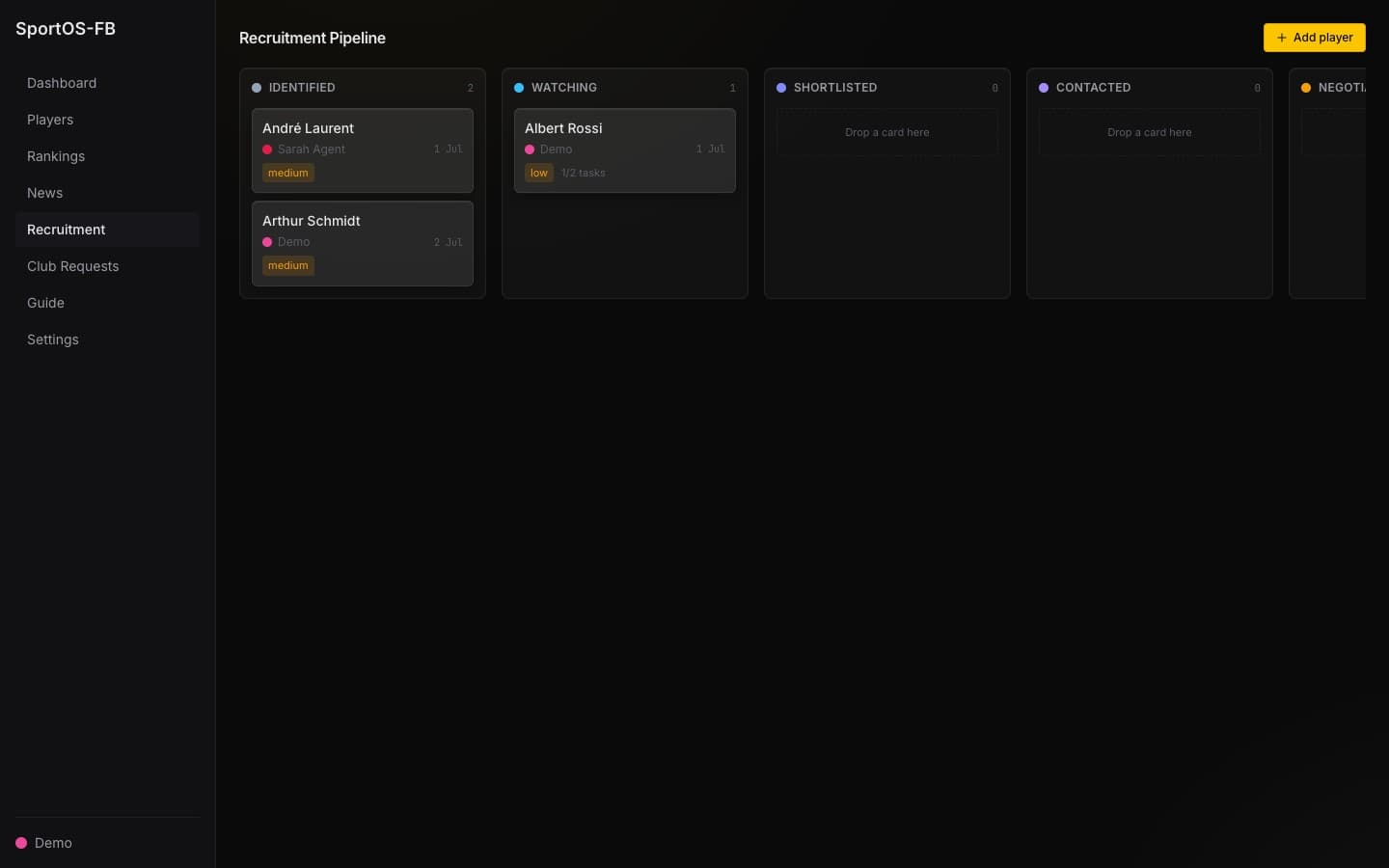
A pipeline that remembers everything
Drag targets through your stages. Assignments, priorities, checklists and dates travel with each card, and every move lands in an audit history that powers time-to-sign and conversion analytics.
Clubs, read from their own transfer record
Every club has a buying habit written down in its own history: the age it signs at, what it pays when it pays, how often it pays nothing at all, and where it shops. Open a club and you also see who it already has in every position - depth, median age, contracts running out, and how much of the minutes the first choice takes. Nobody has ever read that back to them.
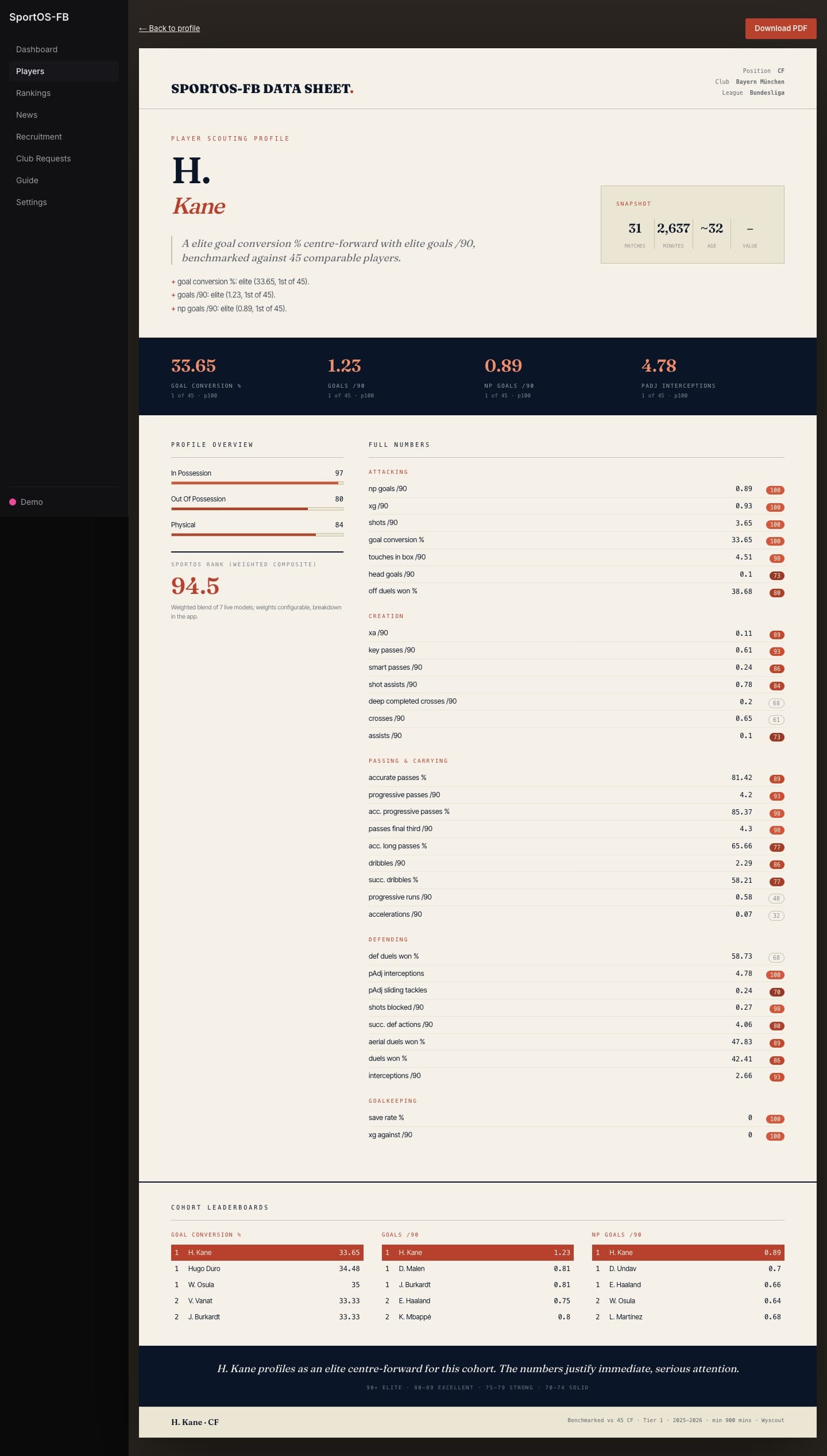
Documents that close deals
The external Data Sheet turns cohort percentiles into a print-grade scouting document for clubs. The internal Fact Sheet assembles career history, caps, honours, injuries and model interpretations for your own war room. Both are generated from live data, editable, versioned and exported to PDF in seconds.
The engine underneath.
The dashboard is the surface. What sits behind it is a set of models built to answer questions the market usually settles with an opinion, each one measured against real transfers and each one willing to say when it does not know.
Who buys this player
Turns a shortlist into a call list. Not “here is a good 21-year-old left-back”, but “here are the clubs whose actual buying pattern matches him, in the fee band each of them actually pays, and whether there is a place for him in the squad”.
Transfer Simulation
A deterministic, inspectable check on one move: does his output survive the level, is there a slot, does this club buy players like this, and how much of that is real evidence. Tested against 4,885 real transfers - it is a risk filter, not a winner-finder, and it filters risk for experienced players rather than young ones. A strong fit means the move is less likely to go badly.
The Step-Up Curve
What actually happens to a player’s numbers when he moves up a level, measured on nearly 3,000 real moves rather than assumed. Promotion and relegation are used as a natural experiment: players who meet a harder league without changing club, manager or country.
Future Value
A trained forecast of which under-23s are most likely to double in market value within three years, back-tested out of time. The forecast is our own model, learning from long-run movement in licensed market data rather than republishing it. It finds the cheap player with room to grow, not the superstar whose value has nowhere left to go.
The Evidence Grade
Every player carries an A to E grade for how much real evidence sits behind his scores - minutes, seasons, metric coverage, identity. A thin player is never presented as a confident one, and the grade always says what would have to change.
It says when it does not know
A missing number is never quietly treated as a zero or an average. Sections that cannot be computed say which input is absent and why, and a verdict resting on a partial picture is capped rather than dressed up. You can argue with every figure because each one shows its own count.
Honest by design: blanks are pending sources, never estimates.
Every number carries its provenance. Percentiles are computed within fair cohorts (position, league tier, age band, minimum minutes), and anything a source cannot supply is shown as pending rather than invented.